ΜΡ ΘΥ
How the Motherof God Saves Us
Recovering the ancient truth about the Theotokos that the modern world forgot
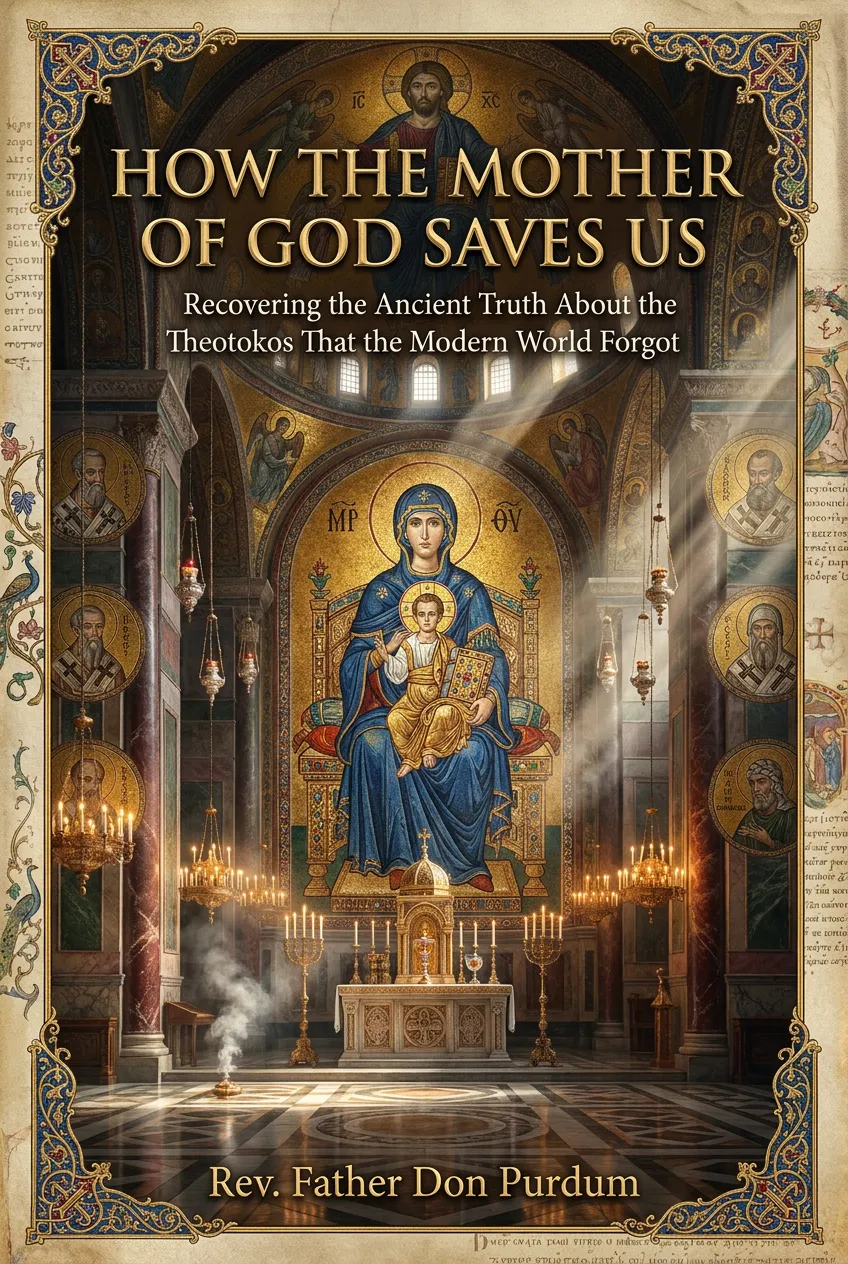
There are four words prayed in nearly every Orthodox service that stop modern Christians in their tracks.
Most Holy Theotokos, save us.
The first time many people hear them, something inside recoils. Save us? Only Christ saves. How can the Church ask the Mother of God to do what belongs to God alone?
If you are Protestant, those words may sound like a theological emergency.
If you are Orthodox, you have probably felt the other version of it — the moment a friend asks “so do you worship Mary?” and you hear yourself say “well, it's our tradition,” and know instantly that you have not answered the question.
You are not alone in either one. Thousands of faithful Orthodox love the Mother of God and cannot explain why. Thousands of Protestants are drawn to the ancient Church — the liturgy, the Eucharist, the Fathers, the unbroken continuity — right up until they meet Mary.
For many, she is the last obstacle.
This book was written to show you that she was never the obstacle. She was the door.
The problem was never Mary
Almost no one rejected the Mother of God because they loved Christ too much. They rejected her because no one ever showed them how the Christians closest to the Apostles understood her.
For fifteen centuries — East and West, Greek and Latin and Syriac and Coptic — Christians honored her without controversy. The argument we now treat as obvious would have been unrecognizable to the men baptized by the disciples of the Apostles.
That does not automatically make the modern instinct wrong. But it should make us pause. And it should make us ask a harder question than the one we usually ask.
The debate about Mary is really a debate about whether God actually makes things holy.
The ancient Christian mind was sacramental. It saw the whole created order shot through with the presence of God — that bread could become the Body of Christ, that water could become a womb of new birth, that a young Jewish girl could carry the uncreated God without the universe collapsing.
To the modern mind, matter is just matter. And if matter is just matter, then Mary is just a delivery vehicle — a biological instrument God used and set aside. Under that assumption, any honor given to her really does look strange.
But if God truly sanctifies what He touches, then the woman who carried Him in her body is the holiest human being who has ever lived, and to treat her casually is not humility.
It is blindness.
The Church was already praying to her
while the blood of the Apostles was barely dry
Beneath your compassion we take refuge, O Theotokos. Do not despise our petitions in time of trouble, but rescue us from dangers, only pure, only blessed one.
This was not written by a medieval pope or a Byzantine emperor. It is a scrap of papyrus from the deserts of Egypt, from the age of the martyrs, when being a Christian could still get you killed. Ordinary believers — hunted and afraid — were already running to the Mother of God and asking her to rescue them.
-
The knot of Eve's disobedience was loosed by the obedience of Mary.
Saint Irenaeus of Lyons · c. 180 · disciple of Polycarp, who was a disciple of the Apostle John -
If anyone does not accept the holy Mary as Theotokos, he is without the Godhead.
Saint Gregory the Theologian · c. 382 · one of the chief architects of the doctrine of the Trinity -
Let Mary be held in honor. Let the Father, Son, and Holy Spirit be worshiped, but let no one worship Mary.
Saint Epiphanius of Salamis · 4th century · the same Church that honored her most guarded most fiercely against worshiping her
Ignatius. Justin. Irenaeus. Athanasius. The Cappadocians. Ephrem. Cyril. An entire ecumenical council at Ephesus. John of Damascus. From the first century to the eighth, in Greek and Latin and Syriac, the witness is one — and every word of it was spoken to defend her Son.
There is no version of ancient Christianity in which Mary is forgotten.
That version is entirely modern.
Luke did not hint. He built the parallel line by line.
The modern reader wants a proof-text. The ancient reader watched for a pattern. Read the first chapter of Luke beside the sixth chapter of Second Samuel and the echoes are too many, and too exact, to be an accident.
| The Ark of the Covenant | The Mother of God |
|---|---|
| The glory of God overshadowed the tabernacle | “The power of the Highest will overshadow you” — the same word |
| David leaped and danced before the Ark | John leaped in the womb at her greeting |
| “How can the ark of the Lord come to me?” | “Why is this granted to me, that the mother of my Lord should come to me?” |
| Remained three months in the hill country | Remained three months in the hill country |
| Held the tablets of the Law, written in stone | Held the Word of God made flesh |
| Held the manna from heaven | Held the true Bread of Life |
| Held the rod of Aaron, sign of the priesthood | Held the great High Priest Himself |
Everything the old Ark held in shadow, the new Ark held in reality. And if the old Ark was so holy that a man died for steadying it with his hand — how should we speak of the one who carried not the symbols of God's presence, but God Himself?
Twelve chapters. Two thousand years of witnesses.
One afternoon of reading.
What is inside
- The Question Beneath the QuestionWhy the modern instinct about Mary came from the last five hundred years — not from the Apostles.
- Her Story in the ScripturesAnnunciation to Pentecost. The word Gabriel used that has no English equivalent. The prophecy in the Magnificat that most churches quietly avoid.
- Her Story in Holy TraditionWhat the Church remembered that the Gospels did not record — and why that is not the same thing as inventing it.
- What the Earliest Church BelievedIgnatius, Justin, Irenaeus — and a prayer on Egyptian papyrus older than the canon of the New Testament.
- The Witness of the Patristic FathersYou cannot keep their Christology and throw away their Mariology. For them the two were never separate.
- The Ever-VirginThe closed gate of Ezekiel, why the doctrine was never about biology, and why Luther and Zwingli both held it.
- Did She Have Other Children?The “brothers of Jesus,” answered from the text itself — including the detail at the Cross that most readers walk straight past.
- The New EveIf Christ is the New Adam — and Paul says plainly that He is — then the question the modern Church forgot to ask is who the New Eve must be.
- The Living ArkThe parallels Luke built on purpose, and what they say about the womb that held God.
- How the Mother of God Saves UsThe word “save” in Scripture is larger than we assume. Paul used it of Timothy. James used it of you.
- Honor, Not WorshipThe distinction the ancient Church always made, what the icons actually claim, and the real fear underneath the objection.
- The Spiritual Reality of the Theotokos in Our LivesShe is our mother, the model of every Christian, and the protection of the Church — in ordinary daily life.
The hard questions, answered plainly
“The Bible says Jesus had brothers.”
It does. It also calls Lot the brother of Abraham, and Jacob the brother of Laban — and both were nephews. More decisively: two of the four “brothers” named in Matthew 13 have a mother identified by name elsewhere in the Gospels, and she is not the Virgin.
“Joseph did not know her until she brought forth her firstborn.”
Michal, the daughter of Saul, had no children “till the day of her death.” The word marks what was true up to a point. It makes no promise about what came after — and Matthew's whole concern in that verse is the virgin birth, not the years that followed.
“Isn't asking her to save us idolatry?”
Paul told Timothy that by watching his life and doctrine he would “save both yourself and your hearers.” James says whoever turns a sinner from error “will save a soul from death.” Nobody thinks Paul was competing with Christ. The word is simply larger than we were taught.
“Why bow before an image?”
Because the honor given to the image passes to the one it represents — which is why you can kiss a photograph of your mother without anyone accusing you of worshiping paper. And because the God who cannot be seen made Himself visible in a body He received from her.
“This is a Catholic thing, not a biblical one.”
Martin Luther called Mary's perpetual virginity an article of faith. Zwingli said she remained “a pure, intact Virgin” before, during and after childbirth. Calvin refused to say Scripture teaches she had other children. The founders of the traditions that reject this today held it themselves.
Written for two readers
If you are Orthodox
- Stop feeling cornered when someone asks about the Mother of God.
- Trade “that's just our tradition” for the theology underneath the tradition.
- See how every Marian doctrine turns out to be a statement about Christ.
- Hear the Divine Liturgy differently — the hymns you have sung for years will open up.
- Pray the Theotokia knowing exactly what you are asking, and of whom.
If you are exploring Orthodoxy
- No pressure, no shaming, no argument you have to lose.
- Scripture first, read the way the people who wrote it actually read it.
- The earliest witnesses, quoted and dated, so you can check every one.
- Every common objection taken seriously and answered on its own terms.
- You may find that your single greatest obstacle becomes one of Orthodoxy's most beautiful treasures.
When you close the last page
You will no longer dread the conversation.
You will know what the earliest Christians believed, and be able to say where they said it.
You will read Scripture with the eyes of the Church that wrote it.
You will understand why the Fathers defended her so fiercely, and what they were really defending.
And when the Church prays those four words, you will not flinch.
They will sound like what they have always been — not a rival to your salvation, but one of its most beautiful and most overlooked gifts.
To honor the Mother is to glorify the Son.
Behold your mother
Nearly everyone had fled. The world had gone dark. And there stood a mother, refusing to leave her dying Son. With almost His last breath, He looked at her, and looked at the disciple He loved, and gave them to each other.
Those words were not only for John. The beloved disciple is anyone who loves Christ.
Most Holy Theotokos, save us.